How to Make AI Work for End-to-End Business Processes
···
As AI becomes part of everyday work, more companies are looking at how to improve the way teams work together across the business.
With new capabilities like Palantir Foundry Ontology, Databricks Genie Ontology, Microsoft Fabric IQ, and OpenAI Frontier, how can we bring them together to make our work easier and more efficient, from product development and manufacturing to sales and customer delivery?
I’d focus on one specific business deliverable, like a customer offer with the right product, price, and delivery commitment. Then, I’d work with the business and process owners to simplify how it gets done, connect the information and decisions involved, and measure the improvement. Once we have results, we can apply the same approach to other workflows.
Here are the key areas I’d focus on:
-
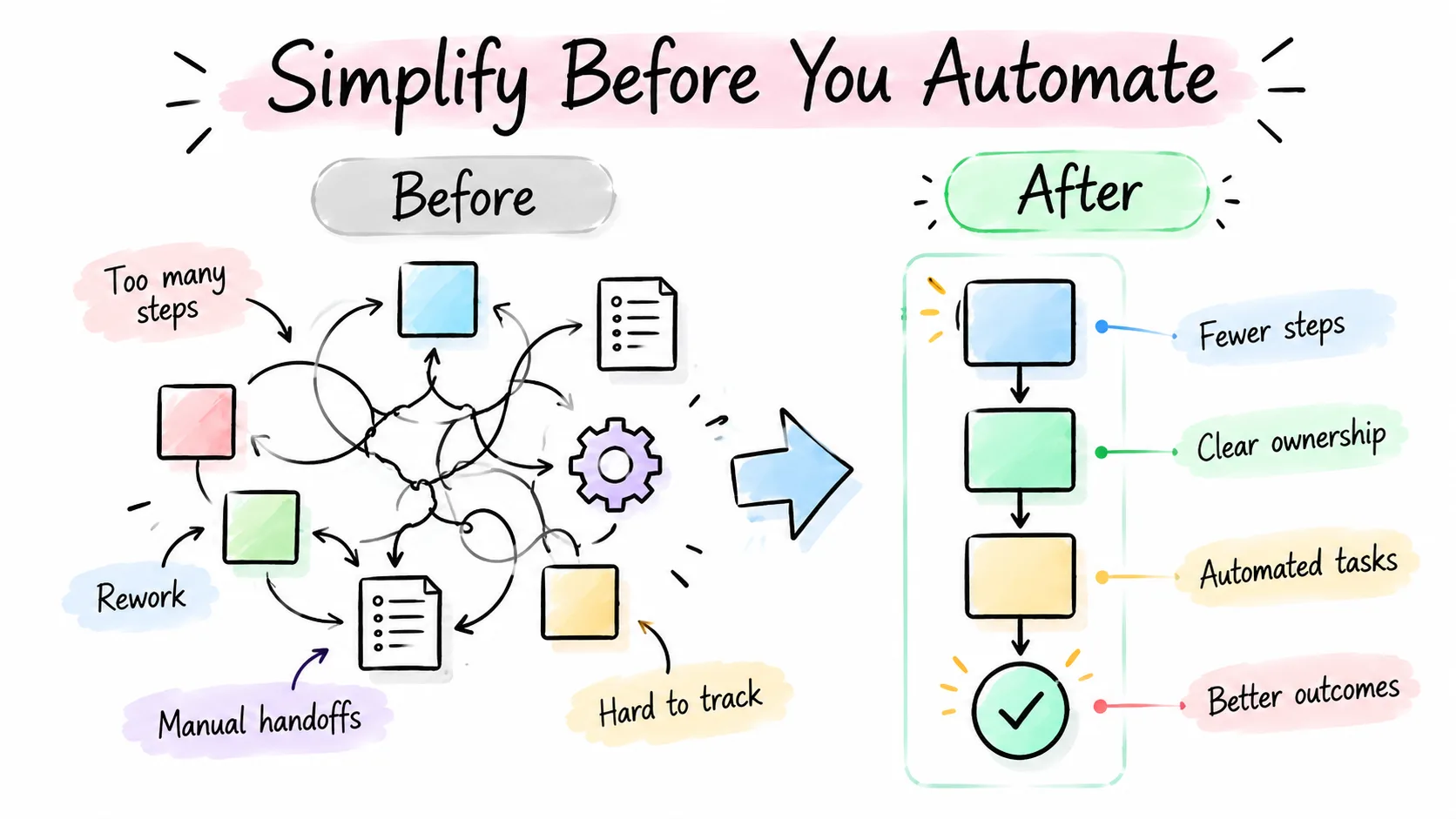
Simplify how work gets done: Remove unnecessary steps, repeated work, and handoffs between teams.
-
Establish a Shared Enterprise Ontology: Connect product information, relationships, and business rules so that different teams and AI agents work from the same understanding of the business.
-
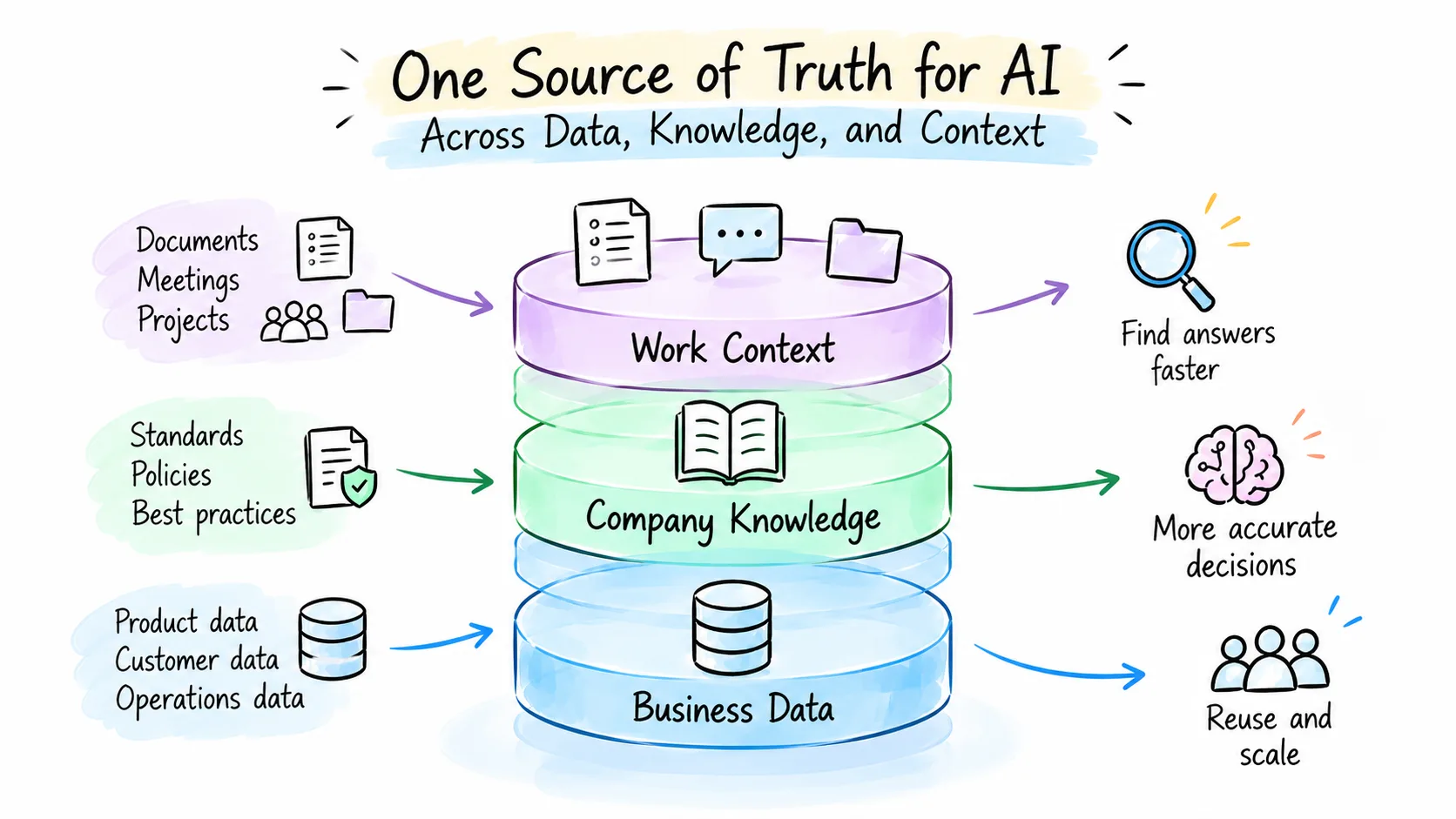
Establish a Shared Intelligence Layer: Bring together reliable business data, company knowledge, and the latest information on what teams are working on.
-
Connect Business Decisions and AI Agent Workflows: Agree on business priorities, who makes each decision, what needs approval, and how work moves from one team to the next.
-
Connect AI Directly to Business Outputs: Make sure approved decisions feed into the actual product designs, production plans, customer offers, and delivery commitments.
···
1. Simplify How Work Gets Done
I’d first identify where engineering, manufacturing, sales, and delivery teams repeat their work, wait for human approvals, or manually pass information between different teams and systems. Then we can remove unnecessary steps, reduce handoffs, keep the quality checks and approvals, and measure how much time and rework we save.
In an AI-assisted packaging review workflow, we examined where people spent most of their time reviewing, waiting for feedback, and repeating the work before deciding which activities AI can execute and improve. As a result, our packaging review time dropped from six hours to an average of 30 minutes, and the overall cycle went from eight to four weeks.
···
2. Establish a Shared Enterprise Ontology
We want to make sure different teams work from the same product information and business rules. It means connecting these things:
-
Product identity: Make sure engineering, manufacturing, and sales can identify the same product even when they use different codes.
-
Relationships: Connect customer needs with product specifications, required components, manufacturing capabilities, and delivery commitments.
-
Business rules: Bring together the rules for product compatibility, quality, manufacturing, pricing, and delivery.
-
Reuse: Let engineering, manufacturing, and sales agents use the same approved product information and business rules.
When a customer requests a product, we need to know which options meet their needs, can be produced, and delivered as promised. In practice, however, comparing information across teams can be challenging, especially when people use different product names, codes, business definitions, or reporting rules.
For example, sales and engineering teams may use different codes for the same product. We need to confirm that they refer to the same product and version before using these information to evaluate customer activities.
AI can help identify possible matches, but the responsible teams will need to confirm them. Once verified, these product relationships and definitions should be reused across teams and agents.
I’d use Enterprise Ontology to bring together product information and business rules from different systems so that AI agents can understand how they relate. The Intelligence Layer provides the latest reliable information, decision rules help compare options, and AI agents help teams carry out the work.
···
3. Establish a Shared Intelligence Layer
When teams calculate the same business metric differently, AI can give different answers depending on which source it uses. I’ve seen how much the quality of AI answers depends on having consistent business definitions and reliable information.
I’d align with the business owners on how each key metric is calculated, which system provides the approved information, and how these definitions can be reused across teams and agents.
To make this work, AI needs access to three types of information:
-
Business data: Product readiness, costs, manufacturing capacity, and delivery status.
-
Company knowledge: Approved product specifications, quality standards, customer agreements, and procedures.
-
Work context: Open issues, pending approvals, and recent decisions across teams.
Microsoft brings these together through Fabric IQ, Foundry IQ, and Work IQ, giving AI access to business data, company knowledge, and ongoing work that agents can use across different tasks.
···
4. Connect Business Decisions and AI Agent Workflows
For each decision, we need to align with the business and process owners on the priorities and what needs approval.
For example, say we’ve already prepared a customer offer, but capacity becomes limited. AI can help identify which products and customer commitments are affected and explore other options, such as offering a different approved product or adjusting the delivery date.
Once the right person approves an option, AI agents can help update the relevant systems and coordinate the next steps across teams. Technologies like OpenAI Frontier and AWS enterprise agent architecture can help connect the agents to systems while keeping the right people in control of approvals and important decisions.
From there, the workflow should:
-
Trigger the appropriate engineering, manufacturing, sales, or delivery activity.
-
Pass approved information to the responsible system.
-
Escalate exceptions to the right person and track completion.
AI can help execute approved decisions, while people remain responsible for approvals and the overall business result.
···
5. Connect AI Directly to Business Outputs
Ultimately, we want AI to help produce the actual business deliverables, such as:
-
Product design: Validated specifications and test requirements.
-
Production plan: Validated product configuration, instructions, and confirmed schedule.
-
Customer offer: Approved product, pricing, commercial terms, and delivery commitment.
-
Customer resolution: Approved solution and completed follow-up.
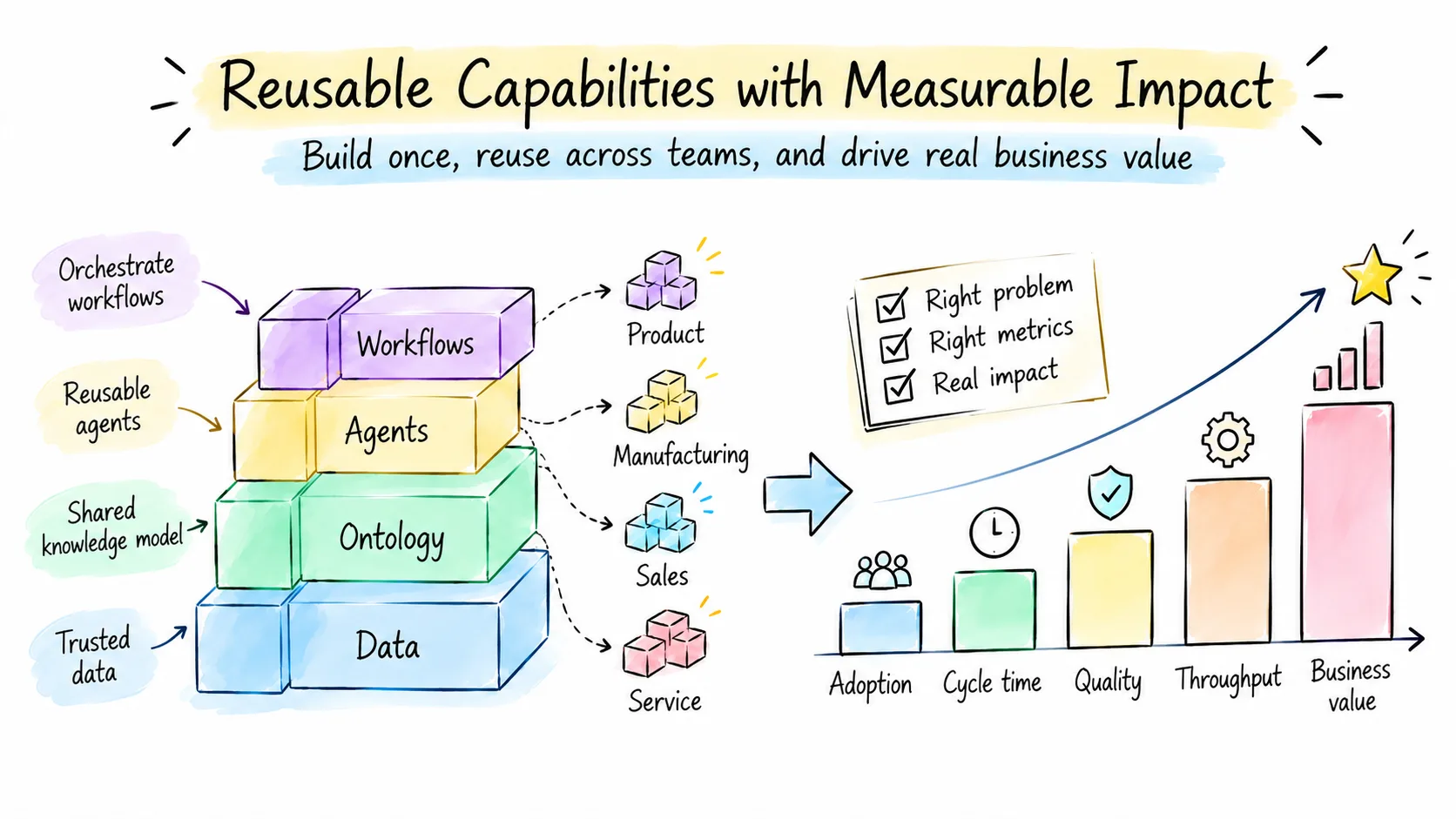
For each deliverable, we need to know who’s responsible, what needs approval, and if the work is actually complete. I’d measure success in these areas:
-
AI adoption: Are people using AI in their daily work?
-
Workflow performance: Are we getting the work done faster with fewer mistakes, less rework, and better quality?
-
Business outcomes: Are we keeping our promises to our customers, improving their experience, reducing costs, and delivering better financial results?
We need to separate time saved from actual savings. If AI helps us launch a product faster, it means the business can generate revenue sooner, reach customers ahead of competition, or reduce development costs. We should measure the actual impact of AI on revenue, costs, and margins rather than assuming that a faster launch automatically delivers financial benefits.
In the packaging review example, we measured the review time, the number of review rounds, and the overall cycle to understand if AI improved the end-to-end process. We then looked at if these improvements helped our teams complete more programs, maintained quality, or reduced the actual spending.
···
Final Thoughts
I’d focus the AI investment on helping teams develop and deliver products faster, respond to customer needs, keep their promises, and improve the customer experience while reducing costs.
Pick one important business deliverable you want to improve, work with the person responsible for it, simplify the process, connect the information and decisions across teams and workflows, and use AI to help deliver measurable results.
This is how we can connect people, processes, data, and AI to serve our customers better, develop products faster, and operate more efficiently.
···
* Author’s Note: All images in this article were created by the author using AI tools.
Post Comment